
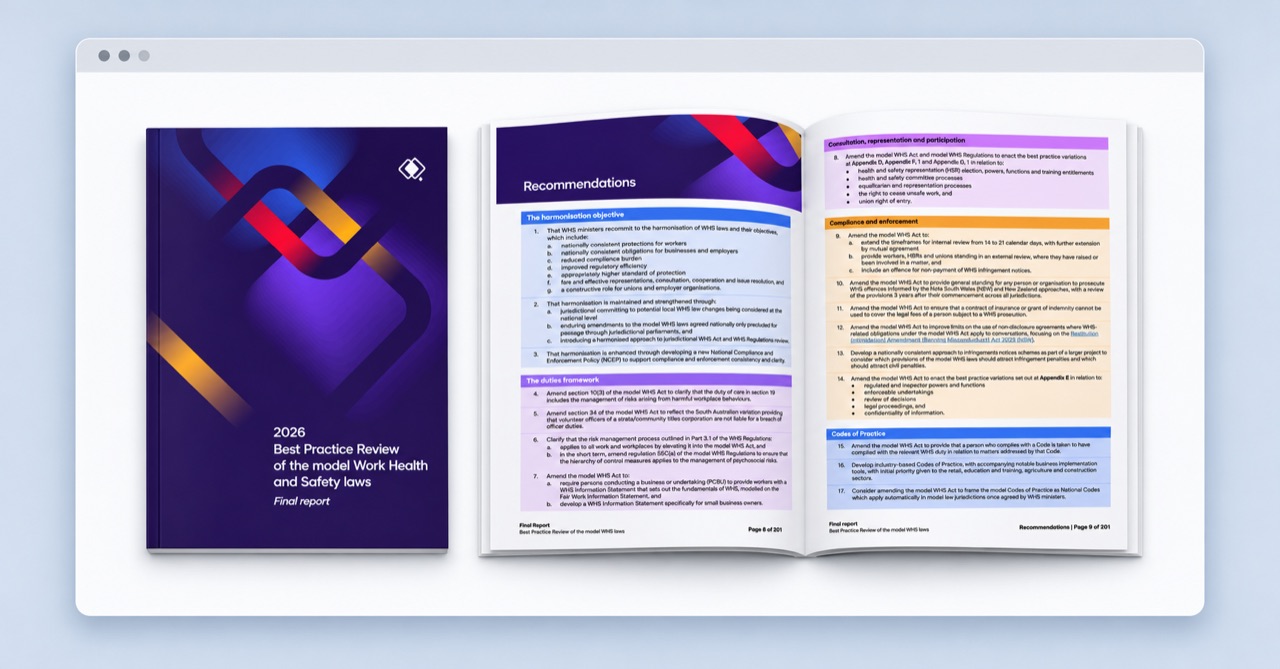
I’ve been working through Safe Work Australia’s 2026 Best Practice Review of the model WHS laws. There is a lot to unpack in its 21 recommendations, so I wanted to share what stood out to me, what is being proposed and where I think the real opportunities sit.
This is a substantial review, with 21 recommendations for WHS ministers and another 13 actions for Safe Work Australia. It covers everything from national consistency and officer duties to consultation, enforcement, AI and climate-related risks. These are proposals at this stage. What changes in practice will depend on government decisions and adoption across the jurisdictions.
What stood out to me
My main takeaway is that the Review supports the overall model WHS framework, but finds that differences in laws, interpretation and enforcement are getting in the way of a consistent national approach. Several familiar problems keep coming through:
Jurisdictional differences are increasing, creating inconsistent obligations and protections.
Regulators and inspectors apply similar laws differently.
WHS knowledge and capability, including among officers and senior managers, need improvement.
Worker consultation is sometimes procedural rather than meaningful.
Codes of Practice are not always sufficiently practical or accessible.
Fatality reductions have slowed, while serious compensation claims have increased.
Emerging technologies, climate-related hazards and harmful workplace behaviours require more coordinated responses.
The Review retains the principles-based legislative approach rather than proposing an entirely new regulatory system.
What the safety data tells us
24%: Reduction in work-related fatality rate between 2014 and 2021
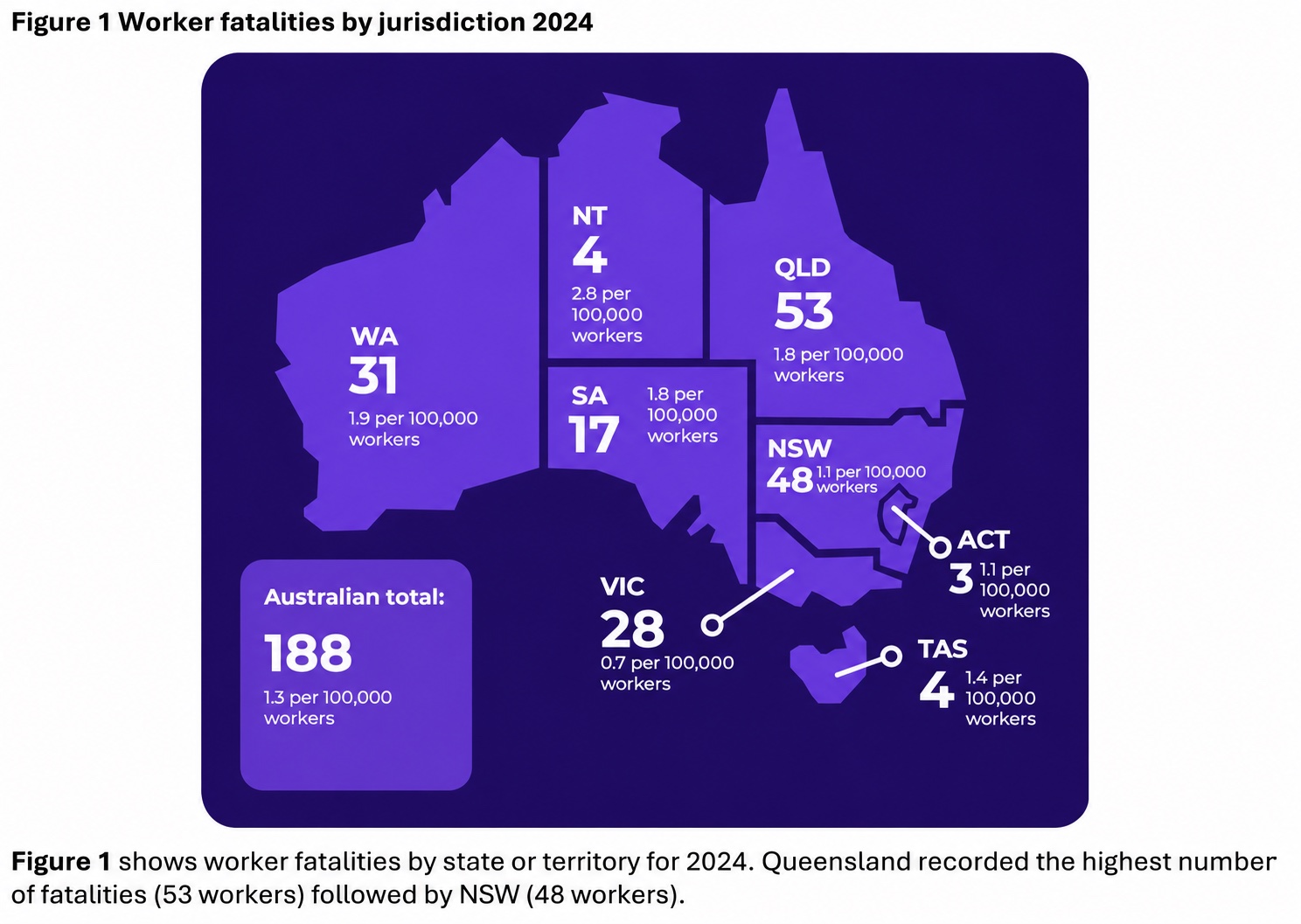
191: Average annual worker deaths from traumatic injuries during 2020 to 2024, as reported by the Review
13.6%: Increase in serious workers' compensation claim incidence, 2018-19 to 2023-24
1.4: Average worker deaths from traumatic injuries per 100,000 workers during 2020 to 2024, as reported by the Review
Source: Review pp. 18, 26 and 160. These fatality figures exclude deaths from disease, natural causes and suicide. The report cautions that compensation trends reflect changing eligibility, awareness and reporting, and that fatality statistics require careful interpretation. These figures provide important context, but do not establish that the WHS laws themselves caused the observed changes.
A closer look at the proposals
Getting more consistency across Australia
Recommendations 1-3 | Report pp. 14-33
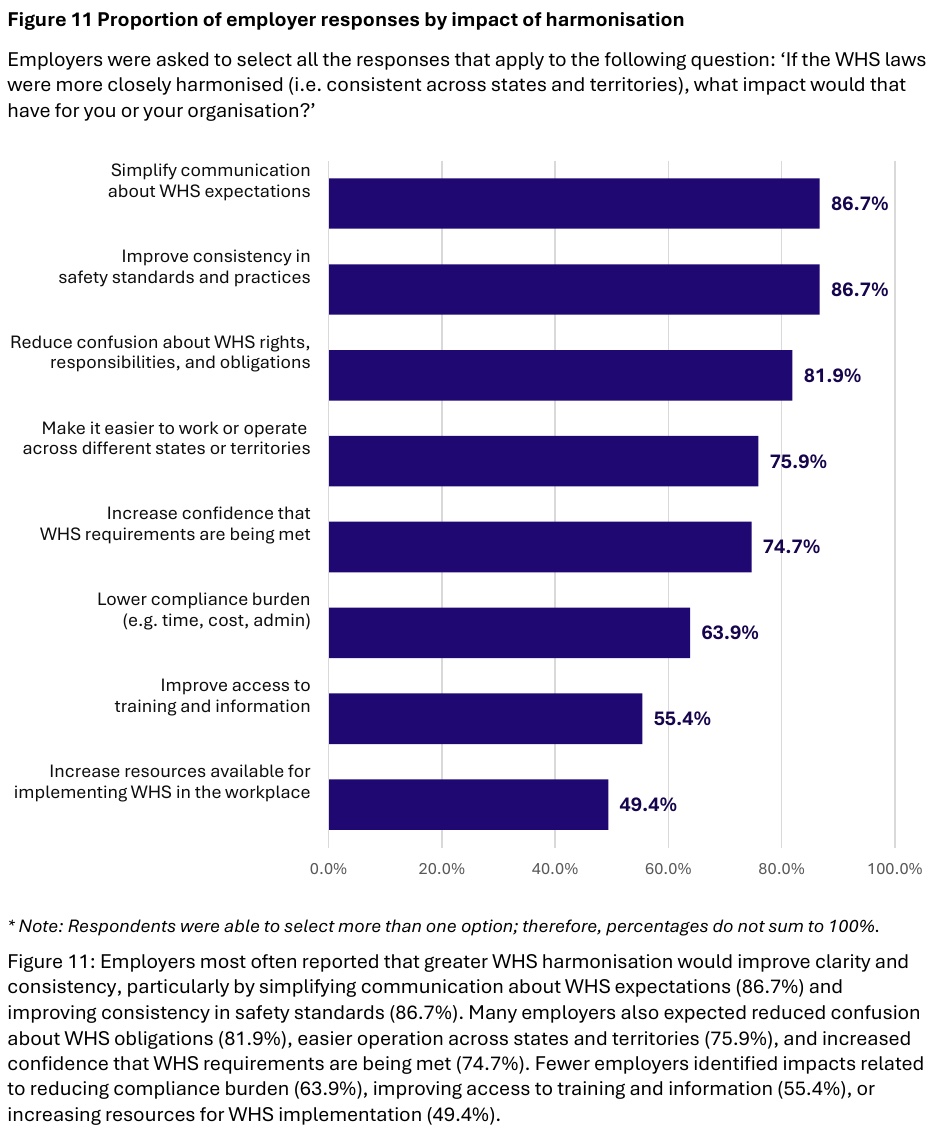
National consistency sounds straightforward, but the Review shows how fragmented the system has become. Although every jurisdiction except Victoria has adopted the model framework, differences remain in legislation, regulations, Codes and enforcement. For businesses working across borders, that means duplicated requirements, inconsistent advice, extra administration and uncertainty about what is expected.
Recommendations 1 and 2 concern recommitment and stronger harmonisation processes, including a harmonised approach to jurisdictional reviews. Recommendation 3 calls for a new NCEP. Together, they seek to:
Recommit WHS ministers to national harmonisation.
Require proposed jurisdictional changes to be considered nationally before implementation.
Prioritise the adoption of nationally agreed amendments.
Develop a new National Compliance and Enforcement Policy (NCEP) with clearer decision-making frameworks for regulators and inspectors.
Safe Work Australia has also committed to developing an annual scorecard identifying jurisdictional variations.
For me, the important distinction is between consistency of legal obligations and consistency of regulatory decision-making. Harmonised legislation is of limited value when substantially similar operational circumstances attract markedly different interpretations. Equally, consistency should not remove the discretion necessary to respond proportionately to actual risk.
Duties, risk management and officer capability
Recommendations 4-7 | Report pp. 34-41
The proposals on duties and risk management are among the ones I’ll be watching most closely.
Recommendation 6: Hierarchy of control measures
The Review recommends elevating the general risk management process from Part 3.1 of the model WHS Regulations into the model WHS Act, so it applies to all work and workplaces. It also recommends applying the hierarchy explicitly to psychosocial risks.
Recommendation 4: Harmful workplace behaviours
Amend section 19(3) to clarify that the primary duty includes managing risks arising from harmful workplace behaviours, such as violence and harassment.
Recommendation 7: WHS Information Statements
Introduce a short statement, modelled on the Fair Work Information Statement, explaining fundamental WHS duties, consultation rights and responsibilities. A separate version would be developed for small business owners.
Recommendation 5: Volunteer strata officers
Amend section 34 to reflect the South Australian provision that volunteer officers of strata or community titles corporations are not liable for a breach of officer duties.
The Review also discusses officer capability and governance. It identifies a likely gap between statutory expectations of officers and how due diligence is operationalised within organisations. Particular concerns include the continued reliance on retrospective safety measures and the tendency for WHS to be approached as a minimum compliance obligation.
Notably, the Review does not recommend changing the definition of reasonably practicable under section 18. Instead, it seeks clearer industry-specific guidance on how the standard should be applied.
I see value in elevating the hierarchy of controls, but its practical value depends on how organisations understand and verify controls. It should not encourage a mechanical exercise in selecting a control category. The important questions remain whether controls address the circumstances creating exposure, whether they work in practice and whether they remain effective as conditions change.
Giving workers a meaningful say
Recommendation 8 | Report pp. 42-62
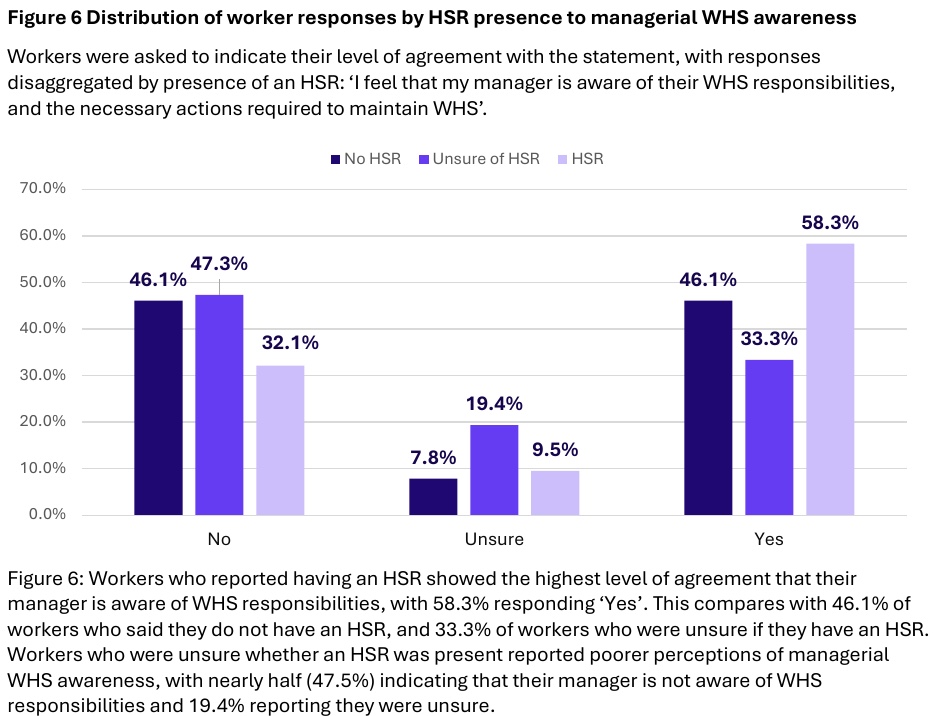
The consultation findings will sound familiar to many people working in safety. The Review describes consultation happening after decisions have effectively been made, HSRs having too little time to do their job, and workers being reluctant to speak up because of the possible consequences.
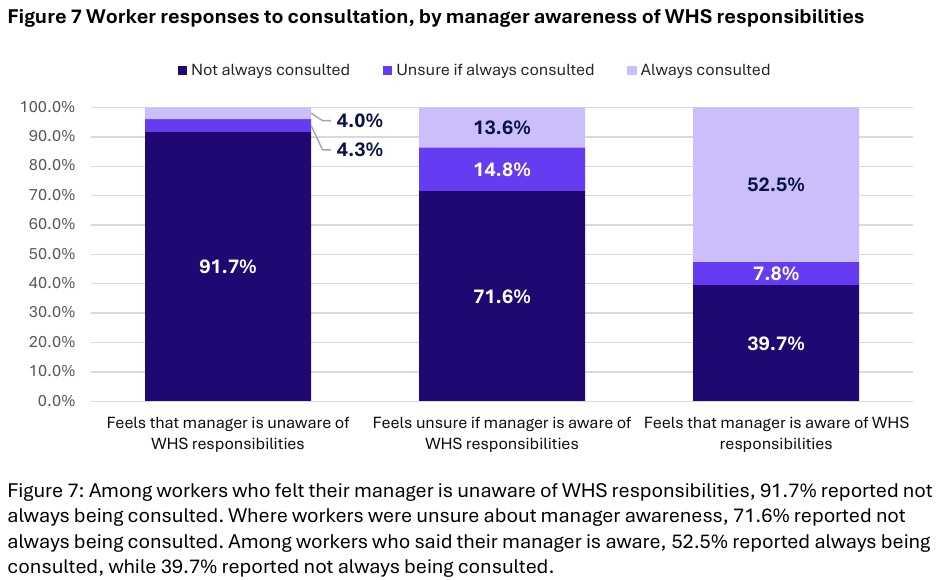
Recommendation 8 covers HSR elections, powers, functions and training, health and safety committee processes, consultation and representation, rights to cease unsafe work and union right of entry.
One specific proposal is to adopt South Australia’s HSR training entitlement approach: five days in the first year, three in the second and two in the third. These are minimum entitlements, with initial training applying again on re-election. The Review also recommends clearer training timeframes and protection against financial disadvantage when representatives undertake their duties.
Another proposal would extend the right to cease unsafe work where a worker reasonably believes the work exposes another person to a serious and immediate or imminent risk.
The report recognises that formal consultation structures may not always suit short-duration projects, transient workforces or complex multi-contractor environments. It proposes further consideration of structured arrangements for these circumstances rather than automatically mandating HSRs everywhere.
This is particularly relevant to events, entertainment, television production and other temporary operational environments. The effectiveness of consultation should be assessed through the quality of participation and its influence on decisions, rather than the presence of a committee or completed consultation record.
What could change in enforcement
Recommendations 9-14 | Report pp. 63-92
There is a lot in the enforcement section. The Review identifies inconsistent inspector powers, investigation quality, enforcement decisions and prosecution arrangements. The main proposals include:
Private WHS prosecutions: Any person or organisation could have standing to prosecute, subject to safeguards
Insurance and indemnity: Prohibit insurance or indemnification for legal fees associated with WHS prosecutions
Non-disclosure agreements: Limit NDAs that compromise WHS rights, reporting or investigations
Internal reviews: Extend the decision timeframe from 14 to 21 calendar days
Regulator powers: Modernise evidence-gathering, investigation and information-sharing powers
Infringement notices: Develop a nationally consistent approach
Affected families: Improve access to relevant information about workplace fatalities and serious incidents
Recommendation 9 also proposes standing for workers, HSRs and unions in external reviews where they have raised or been involved in a matter, and an offence for non-payment of WHS infringement notices. The internal review period could be extended further by mutual agreement.
Recommendation 14 includes enforceable undertakings and alternative verdicts for industrial manslaughter and Category 1 and 2 offences, alongside investigation and information-sharing reforms.
The private prosecution proposal is especially significant. The Review recommends that private proceedings be available where regulators have decided not to prosecute, informed by safeguards used in NSW and New Zealand. It also recommends reviewing the arrangements three years after their commencement across all jurisdictions.
On industrial manslaughter, the Review notes substantial differences between jurisdictions but does not recommend a single national offence at this stage. It considers the existing case law insufficient to determine a preferred model.
The Review also proposes examining whether financial penalties for very large corporations are sufficiently proportionate to their scale and capacity.
These changes could materially affect corporate governance, insurance arrangements and enforcement exposure. There is also a significant opportunity to strengthen investigative capability. Better enforcement requires more than additional powers. It requires competent investigation, sound technical understanding, procedural fairness and the ability to distinguish the conditions that contributed to an event from conclusions reached with hindsight.
Why the changes to Codes matter
Recommendations 15-17 | Report pp. 93-97
The changes proposed for Codes of Practice deserve a close look, particularly for organisations and safety practitioners who rely on them for practical guidance.
The Review recommends adopting an approach similar to Victoria's, under which a person who complies with an applicable Code is taken to have complied with the relevant WHS duty for matters addressed by that Code. It does not recommend making Codes universally mandatory.
The Review also recommends developing practical industry Codes, initially prioritising retail, education and training, agriculture and construction.
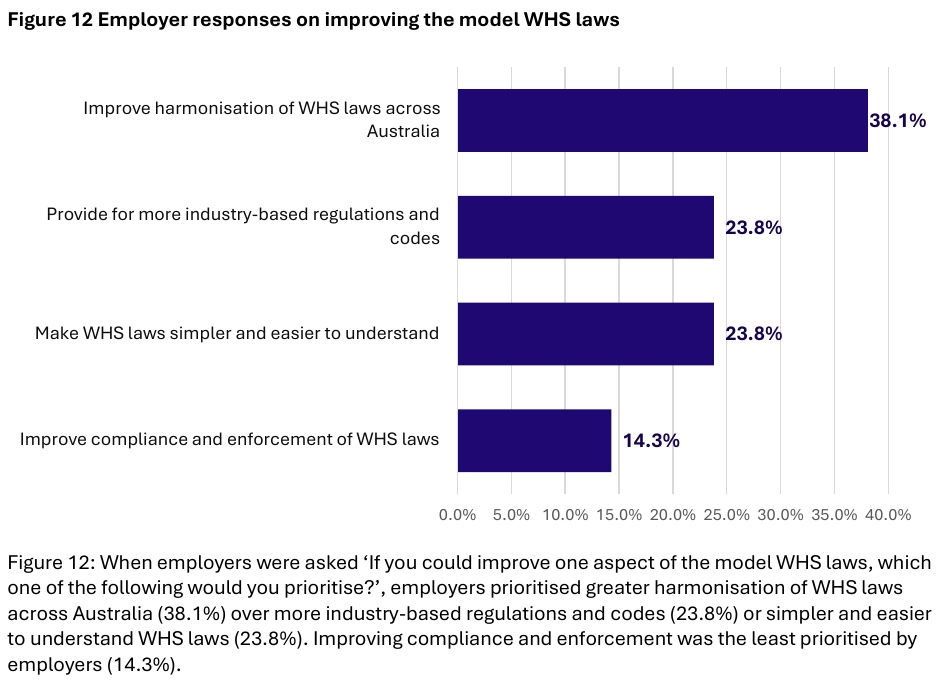
Proposed approach to Codes
Under the proposed approach, following a Code would establish compliance for the matters it addresses. An alternative approach would remain available, subject to meeting the relevant legal duty. This is a proposed framework, not enacted law. Recommendation 17 asks ministers to consider National Codes that would apply automatically in participating model-law jurisdictions once agreed by WHS ministers, subject to legislative changes.
My concern is that, while the deeming proposal could improve clarity, it introduces an important assurance question. Evidence that a Code has been followed is not necessarily evidence that the resulting arrangements remain effective under actual operating conditions. The proposed approach needs to preserve innovation and avoid making documentation the primary measure of safety performance.
Updating the WHS Regulations
Recommendation 18 | Report pp. 98-114
The Review proposes a comprehensive update of the WHS Regulations. The scope is broad: construction project definitions, high-risk work licensing, automated plant, amusement devices, dangerous goods, lithium batteries, diving, occupational exposures and emerging industrial technologies.
Some specific proposals include:
Replacing the monetary construction project threshold with a workforce-based definition informed by Western Australia's approach.
Allowing digital construction induction cards nationally.
Adopting NSW's emergency planning notification requirements for sites with 25,000 kilograms or more of lithium batteries.
Reviewing licensing requirements for automated high-risk plant.
Improving national consistency for amusement device registration and competent-person arrangements.
Importantly, the Review rejects some additional documentation requirements. For example, it does not recommend nationally adopting Queensland's separate sexual harassment prevention plan requirement, preferring regulation focused on practical prevention controls.
To me, this recognises something we see too often: adding another plan does not necessarily improve how a hazard is managed. I would judge modernisation by whether the resulting obligations are clearer, relevant to the work and effective in practice.
AI and the way work is changing
Recommendation 19 | Report pp. 115-121
AI is already changing how work is organised and managed. The Review recognises the opportunities for better monitoring and decision support, alongside risks involving work design, workload, psychosocial exposure and automated decisions. The Review favours technology-neutral legislation rather than introducing an entirely separate legal duty for AI.
Recommendation 19 proposes a national strategy to monitor how WHS laws are interpreted, applied and enforced for digital technologies; address identified gaps through Regulations, Codes or Act amendments; clarify uncertainty through industry Codes; and support research producing practical workplace solutions.
This has important implications for organisations adopting AI-enabled operational and safety systems. The focus should extend beyond the technical performance of the software to the decisions it influences, the information available to users, human oversight and the potential for new dependencies or unintended consequences.
Climate and changing working conditions
Recommendation 20 | Report pp. 122-127
The Review recommends a national climate change strategy incorporating new model WHS Regulations addressing:
Extreme heat.
Air quality.
Vector-borne diseases.
It also proposes research, industry guidance, monitoring and amendments where gaps are found, with stakeholder engagement and WHS integrated into whole-of-government climate adaptation.
This is particularly relevant to outdoor work, construction, agriculture, sporting events, emergency response and mobile operations. The challenge is that environmental conditions can change rapidly and create interacting risks. Effective arrangements need to support timely operational decisions, including modification, suspension or cancellation of activities.
Preventing harmful workplace behaviours
Recommendation 21 | Report pp. 127-131
The Review proposes a national strategy on workplace violence, harassment, gender-related violence and other harmful behaviours. What interests me here is the attention to prevention through the way work is designed and organised.
Proposals include clarifying the primary duty of care, regulations on facilities including female-designated toilets and prevention of work-related violence and harassment, and stronger evidence for system-level controls. The strategy would improve understanding of existing duties and promote transparent, consistent enforcement through the NCEP, Codes and supporting material.
The report particularly highlights the importance of workplace design, organisational conditions and access to appropriate amenities.
This moves the discussion beyond responding to individual complaints towards preventing exposure through better organisational arrangements. The Review's emphasis on system-level controls is consistent with the need to examine how work is structured, how authority is exercised and how organisational decisions influence exposure.
The 21 recommendations at a glance
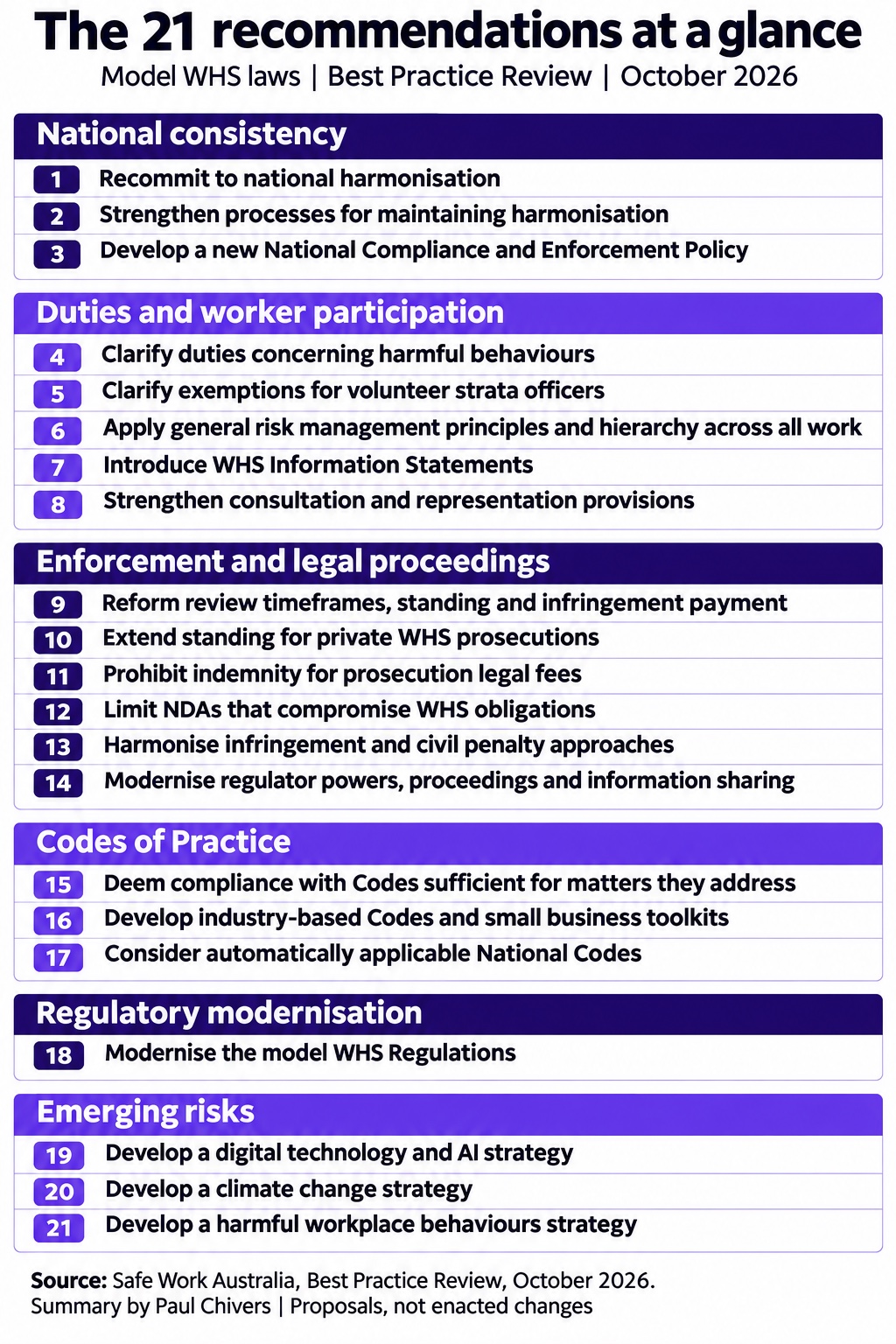
Read the 21 recommendations as text
- Recommit to national harmonisation
- Strengthen processes for maintaining harmonisation
- Develop a new National Compliance and Enforcement Policy
- Clarify duties concerning harmful behaviours
- Clarify exemptions for volunteer strata officers
- Apply general risk management principles and hierarchy across all work
- Introduce WHS Information Statements
- Strengthen consultation and representation provisions
- Reform review timeframes, standing and infringement payment
- Extend standing for private WHS prosecutions
- Prohibit indemnity for prosecution legal fees
- Limit NDAs that compromise WHS obligations
- Harmonise infringement and civil penalty approaches
- Modernise regulator powers, proceedings and information sharing
- Deem compliance with Codes sufficient for matters they address
- Develop industry-based Codes and small business toolkits
- Consider automatically applicable National Codes
- Modernise the model WHS Regulations
- Develop a digital technology and AI strategy
- Develop a climate change strategy
- Develop a harmful workplace behaviours strategy
The other work Safe Work Australia is taking forward
Alongside the recommendations for ministers, Safe Work Australia Members have agreed to progress another 13 actions. These matter because work can move ahead without waiting for the full legislative reform program.
These include an annual harmonisation scorecard, new strategic groups addressing enforcement and fatalities, faster sharing of coronial findings, improved access to court decisions, consideration of alternative sentencing, examination of penalties for large corporations, establishment of a technical expert panel and clearer advice about AI.
What I’ll be watching
For me, six things will determine whether this makes a practical difference:
Control effectiveness: Whether elevating the hierarchy improves operational risk control or simply changes assessment documentation.
Officer due diligence: Whether boards receive better information about actual operating conditions, emerging vulnerabilities and critical controls. Injury rates and completed actions alone cannot demonstrate that risks are being managed effectively.
Codes of Practice: Whether deemed compliance supports clarity without discouraging better approaches or reducing critical scrutiny of actual conditions.
Consultation: Whether workers meaningfully influence decisions, particularly in complex, temporary and multi-contractor work environments.
Investigation and learning: Whether national fatality analysis develops stronger understanding of the interactions between decisions, resources, technology, supervision, competing objectives and everyday adaptations. Investigations should examine the conditions shaping work, rather than stop at an individual’s departure from a procedure.
Adaptability: Whether organisations can respond to changing technology, environmental conditions and harmful behaviours through better work design and timely decisions.
I see a real opportunity here to strengthen how we manage work health and safety. The test will be whether these reforms help organisations understand risk, make better decisions, check that controls work and learn from everyday work. A completed risk assessment, an approved procedure or a green dashboard tells us that something has been done. It does not, on its own, tell us whether the arrangements work in the conditions people actually face.
That is where I think we need to keep our attention: how work normally succeeds, where people adapt to make it possible, and which organisational decisions increase or reduce exposure. Consultation, assurance and investigation should help us understand those things. For me, the question is whether these proposals will help us achieve better practice in the workplace.
Read the original report
Safe Work Australia, Best Practice Review of the model Work Health and Safety laws, Final Report, October 2026. Published 19 October 2026.
Download the complete original report (PDF, 201 pages)
Official publication page and accessible Word version
Source material: Safe Work Australia, October 2026. The report text is licensed under Creative Commons Attribution 4.0, excluding the Safe Work Australia logo.