
The Visible Response
On 13 June 2026 a shark bite at Coogee triggered the kind of media cycle that reshapes a program overnight. Within weeks, Surf Life Saving NSW's own reporting recorded more than 3,000 media mentions and an estimated $30 million in coverage value tied to the incident and the state's drone response. Since the expanded program began on 1 July, a further 500-plus media mentions and roughly $5 million in coverage value have followed, for the drone program alone.[4]
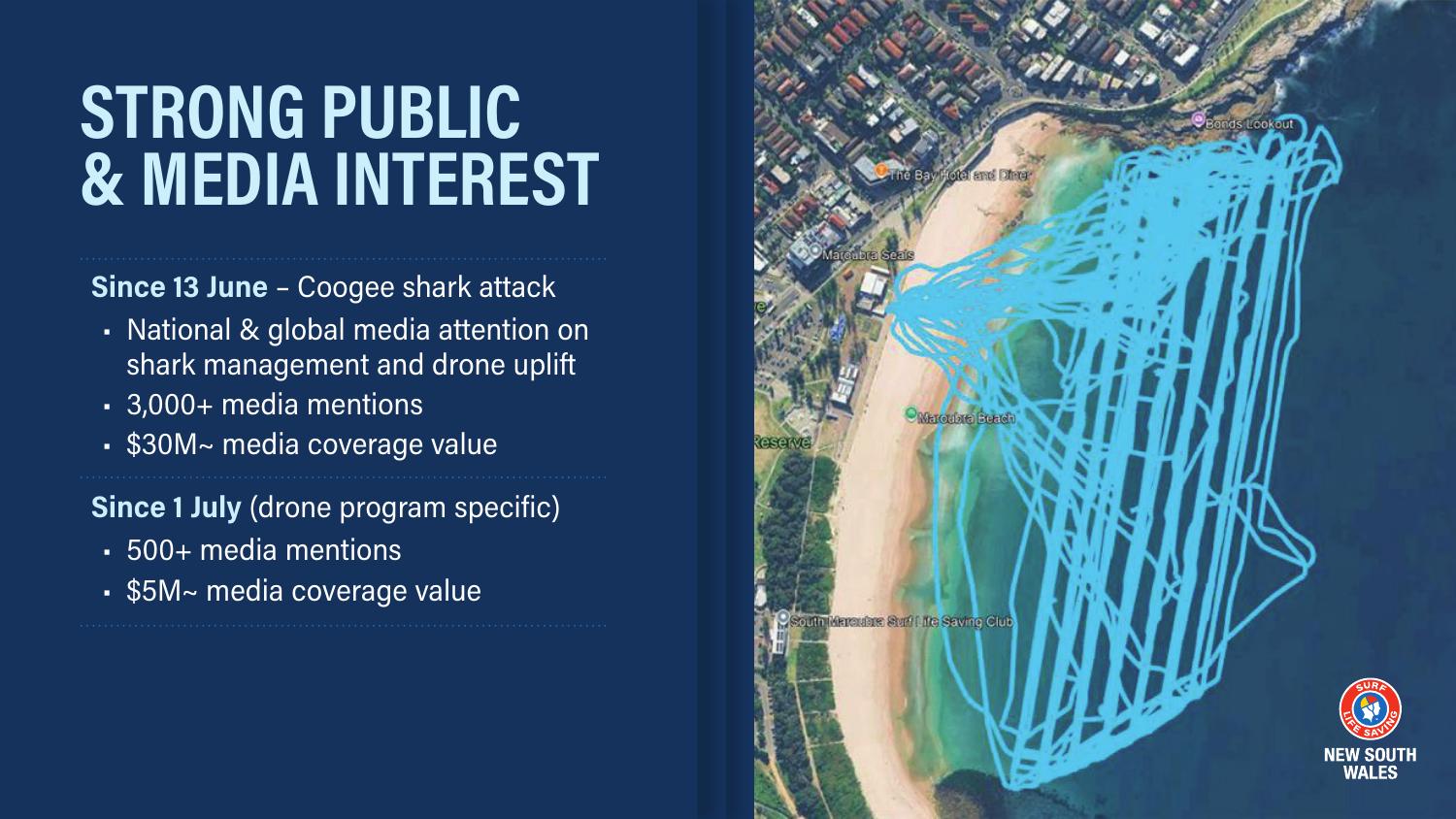
The operational uplift behind that coverage is real and substantial. What began in 2017 as an eight-site trial on the state's Far North Coast is now a 200-plus drone fleet, flown by 300-plus pilots, patrolling 73 beaches from dawn to dusk, backed by a Remote Operations Centre and a growing network of autonomous drone-in-a-box units. It is one of the largest coastal surveillance build-outs of its kind anywhere in the world.[4]
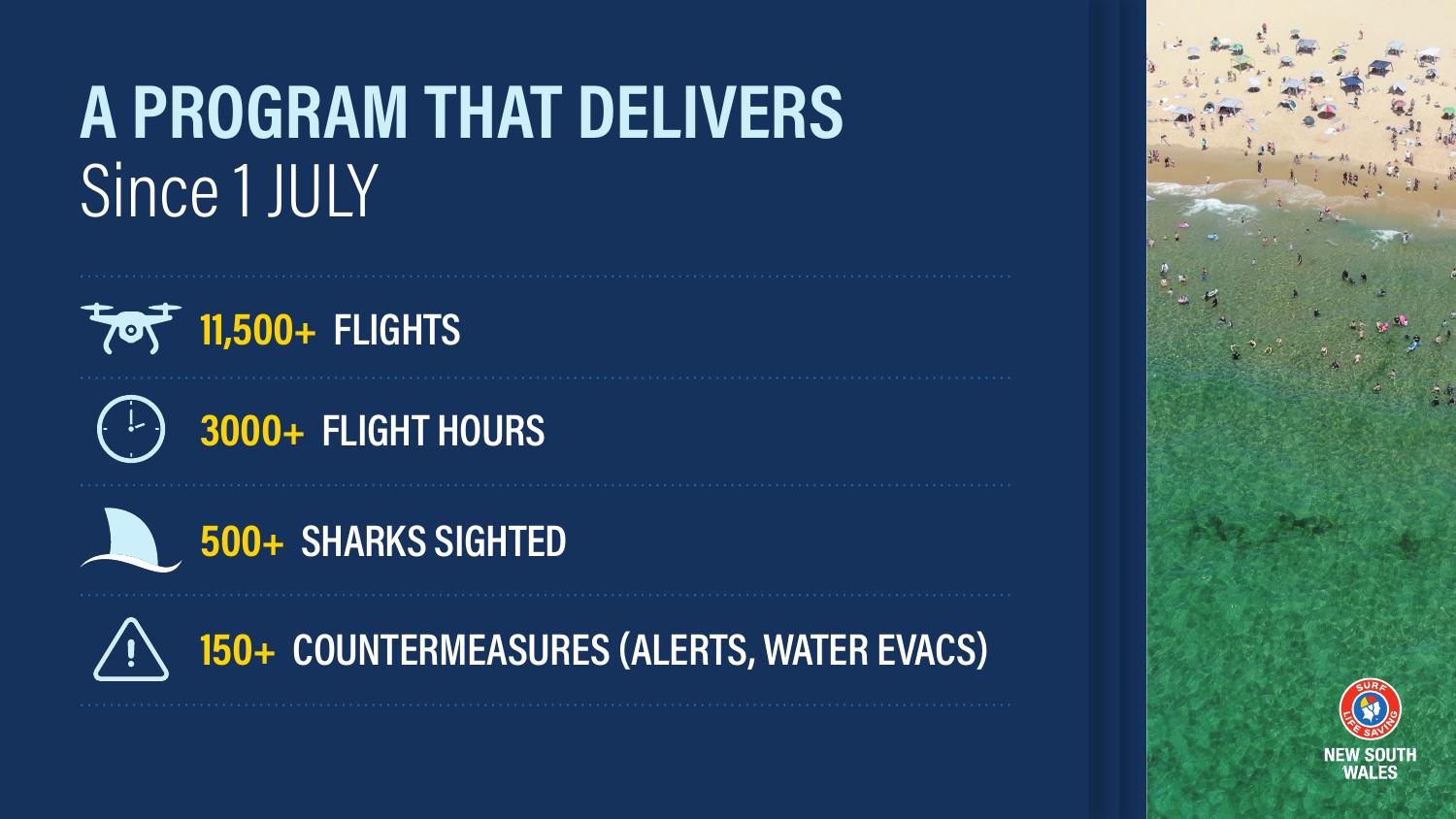
None of that is a criticism of the people flying the drones, who by every account are doing a genuinely useful job. The question this piece asks is a governance one: is the pace and scale of that response being set by the underlying risk, or by the media cycle sitting on top of it? Three other presentations delivered during the same conference session, from the regulator's own shark scientist, from an epidemiologist working the national bite database, and from a public policy researcher who has spent a decade studying exactly this dynamic, give a fairly direct answer.[1][2][3]
What the Regulator's Own Data Says
NSW Department of Primary Industries and Regional Development, the agency that owns the Shark Management Program, gave summit delegates a considerably more measured picture than the one running in the media. The presentation was delivered by Marcel Green of DPI.[3]
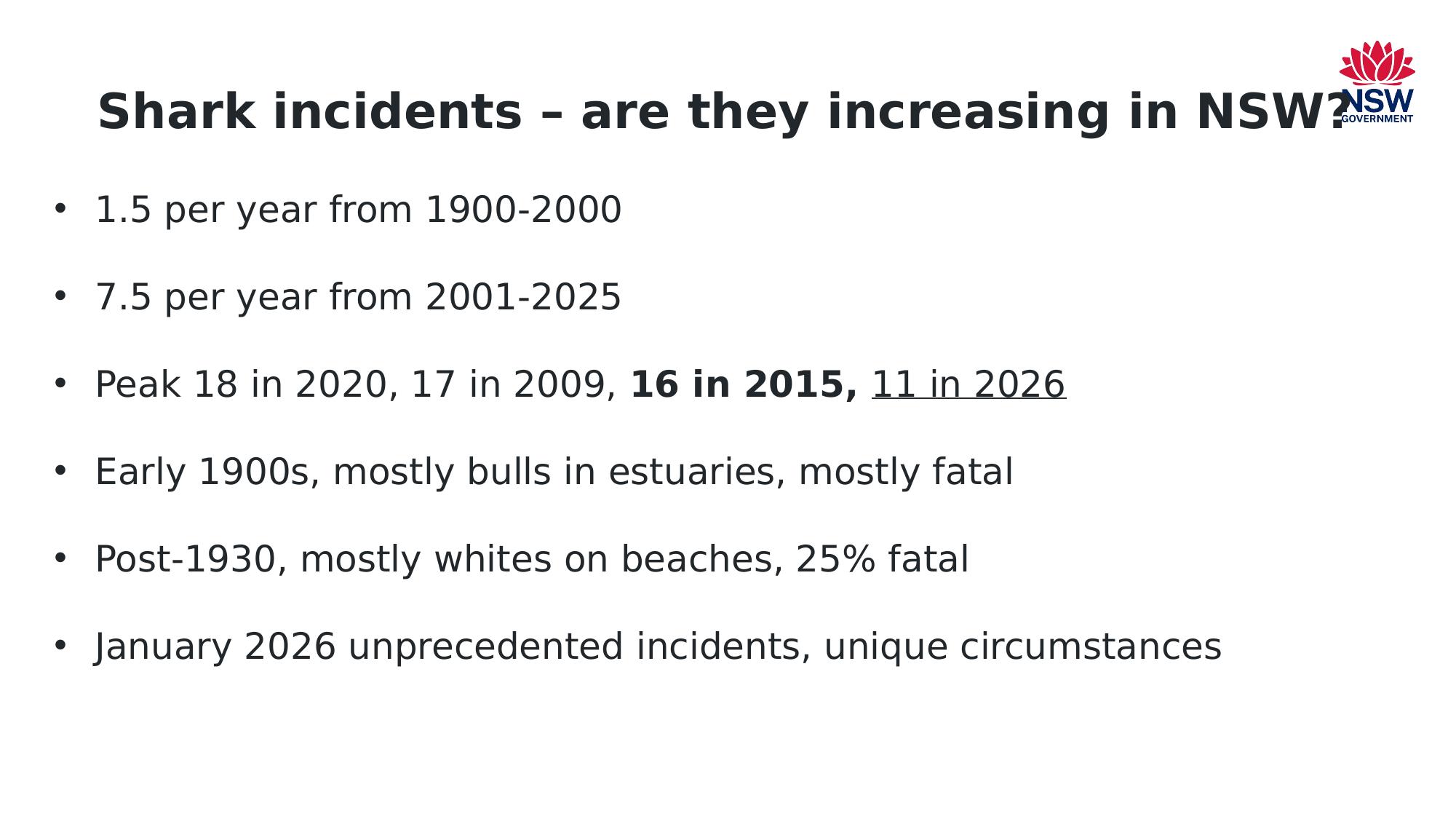
Yes, the long-run incident rate has risen, from roughly 1.5 unprovoked incidents a year across 1900–2000 to about 7.5 a year since 2001. But 2026's tally of 11 incidents sits below the peaks recorded in 2020 (18) and 2009 (17). DPI describes the January 2026 cluster, four bull shark incidents in 36 hours, three at beaches and one in a harbour, on beaches with no prior recorded bull shark incident, as “unprecedented” and attributes it to a specific rain event that is understood to shift bull sharks out of estuaries and onto open beaches. That is a description of a discrete, weather-linked anomaly, not a structural step-change in background risk.[3]
The more consequential slide is the one that never made the media cycle. DPI's own tracking and SMART drumline data show that shark detections and shark bite incidents do not move together. The Northern Beaches, where the January cluster occurred, have recorded roughly 1,000 bull shark detections since 2023. South West Rocks has recorded more than 5,000; Evans Head more than 15,000; Yamba more than 40,000, with no incidents at all on the north coast across that period. DPI's own conclusion, stated plainly to delegates, is that “relative abundance does not necessarily equate to incidents”. That is the regulator's own science contradicting the sightings-equals-danger logic that public communications, including the drone program's own marketing, implicitly leans on.[3]
This matters for a systems view of the risk: the causal chain from “more sharks near a beach” to “more bites at that beach” is not established in the regulator's own dataset. Whatever is driving incident risk, raw shark presence is not a reliable leading indicator of it, which has direct implications for how much weight a visible-surveillance response can carry as a control.[3]
The Actual Scale of the Hazard
Madeline Riley of Flinders University and the Southern Shark Ecology Group, working from the Australian Shark Incident Database, a record running back to 1791, confirmed the long-run increase in bite numbers, now sitting around 20 a year nationally, and identified NSW, Queensland and WA as the persistent hotspots. Her data also shows the proportion of bites that are fatal has fallen sharply since 1960, a trend she attributes to better medical response, first-aid training and public understanding. That decline has flattened since 2000, however, meaning the raw number of serious outcomes is not falling in step with raw incident growth.[1]
Set against other causes of coastal death, the comparative base rates are stark. Shark bites average around 3 deaths a year nationally. Rip currents average around 22. Beach-related drowning generally averages around 64. Coastal drowning overall averages around 127. None of this makes an individual shark bite less traumatic for the person it happens to. Riley's data on injury patterns, showing torso injuries as the dominant cause of fatality, is being used constructively to inform bite-resistant wetsuit design. But as a population-level safety-allocation question, the comparison matters.[1]
The Public Already Knows This
The most striking material came from Dr Chris Pepin-Neff, Associate Professor in Public Policy at the University of Sydney, whose research program is explicitly built around the gap between shark-bite policy and shark-bite risk. His framing is that policy response to emotionally charged, low-probability events is set by “political distress”, the convergence of a perceived problem, the people it matters to and the timing, rather than by the underlying hazard.[2]
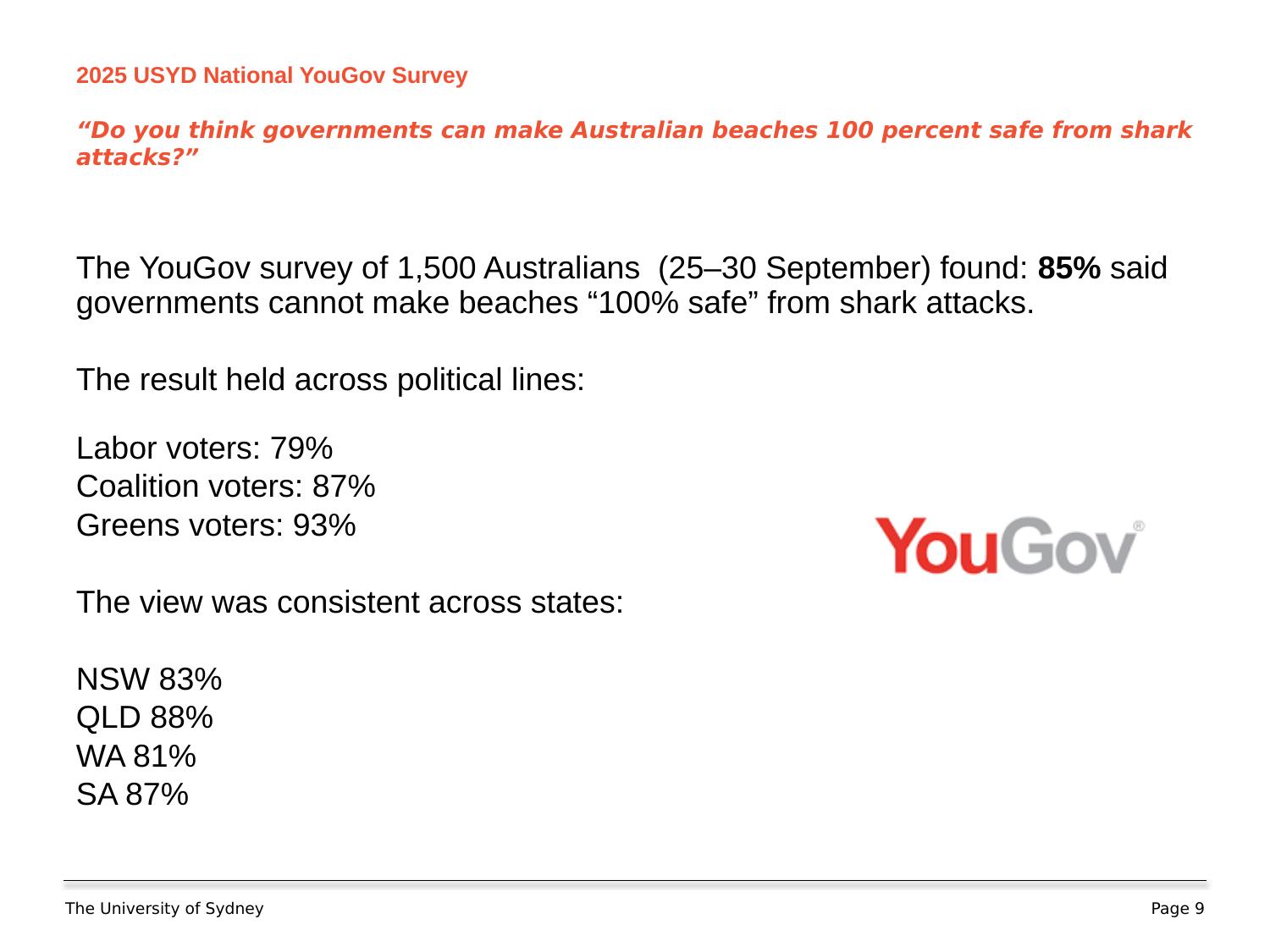
His survey evidence backs the theory. A 2025 national YouGov poll of 1,500 Australians found 85% already believe governments cannot make beaches “100% safe” from shark bites, a view that holds at 79–93% regardless of political affiliation and 81–88% regardless of state. Separate NSW and WA surveys found more than 60% of respondents believe “no one” is to blame when a bite occurs, and 75–83% want government to invest in non-lethal responses over lethal ones.[2]
Asked directly who is at fault when a bite occurs, the plurality answer in both NSW and WA survey samples is “no one”, not the shark, not the swimmer and not government.[2]
When asked what governments should do about it, the preference for non-lethal measures over lethal ones is not close: 82.8% in NSW and 75.5% in WA.[2]
The public, in other words, is not the one demanding disproportionate, visible, lethal-leaning intervention. The most telling data point in the body of research is what the public itself believes is motivating government when it responds aggressively.[2]
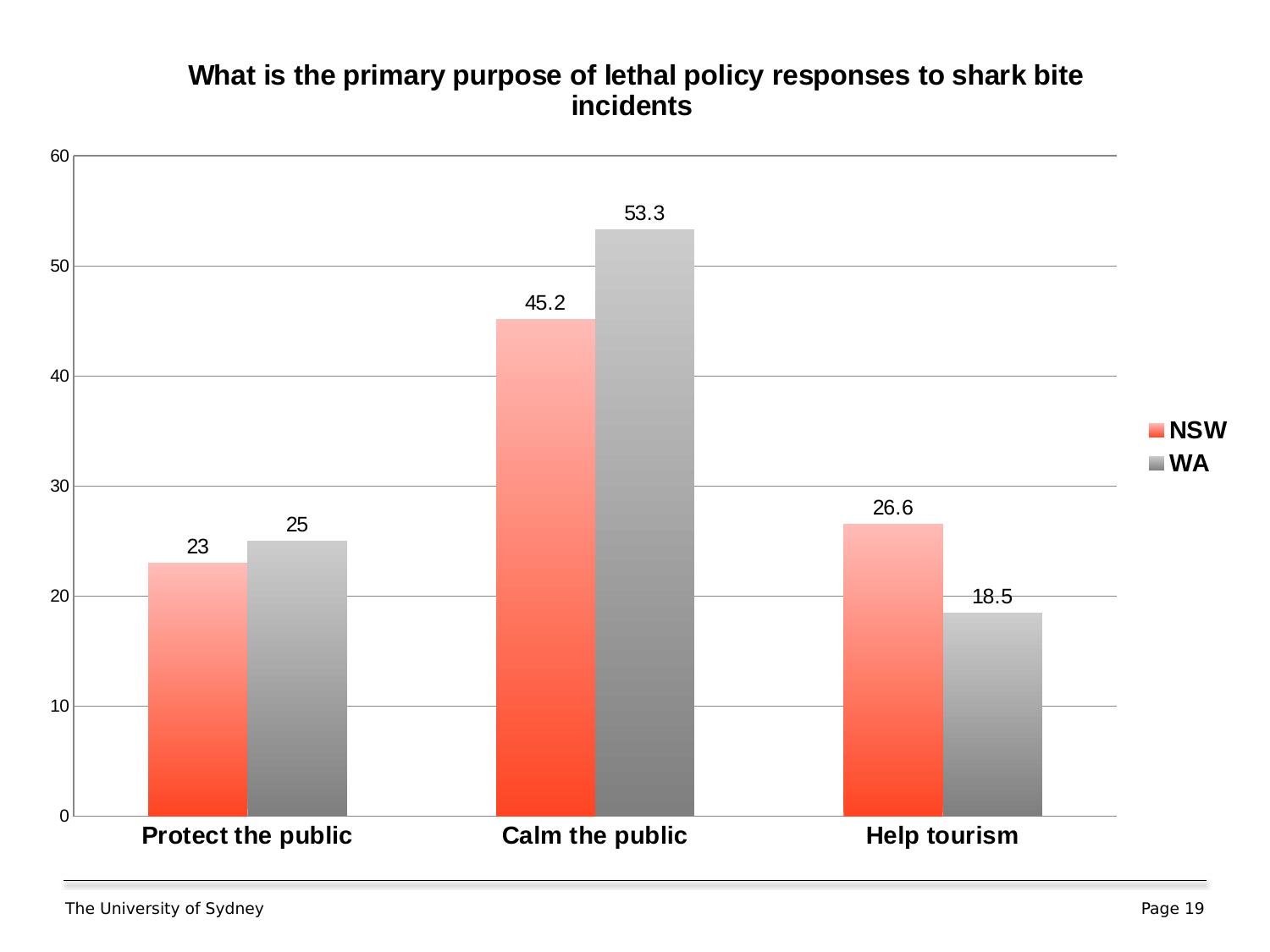
Only 23–25% of respondents believe lethal responses are primarily deployed to protect the public. Between 45% and 53% believe the primary purpose is to calm the public. That is not a fringe or cynical reading. It is the plurality view and a public-perception finding, not an activist claim. People experiencing the policy response can see the reassurance function operating alongside, or instead of, the protective one.[2]
The Program's Own Risk Register Says the Same Thing
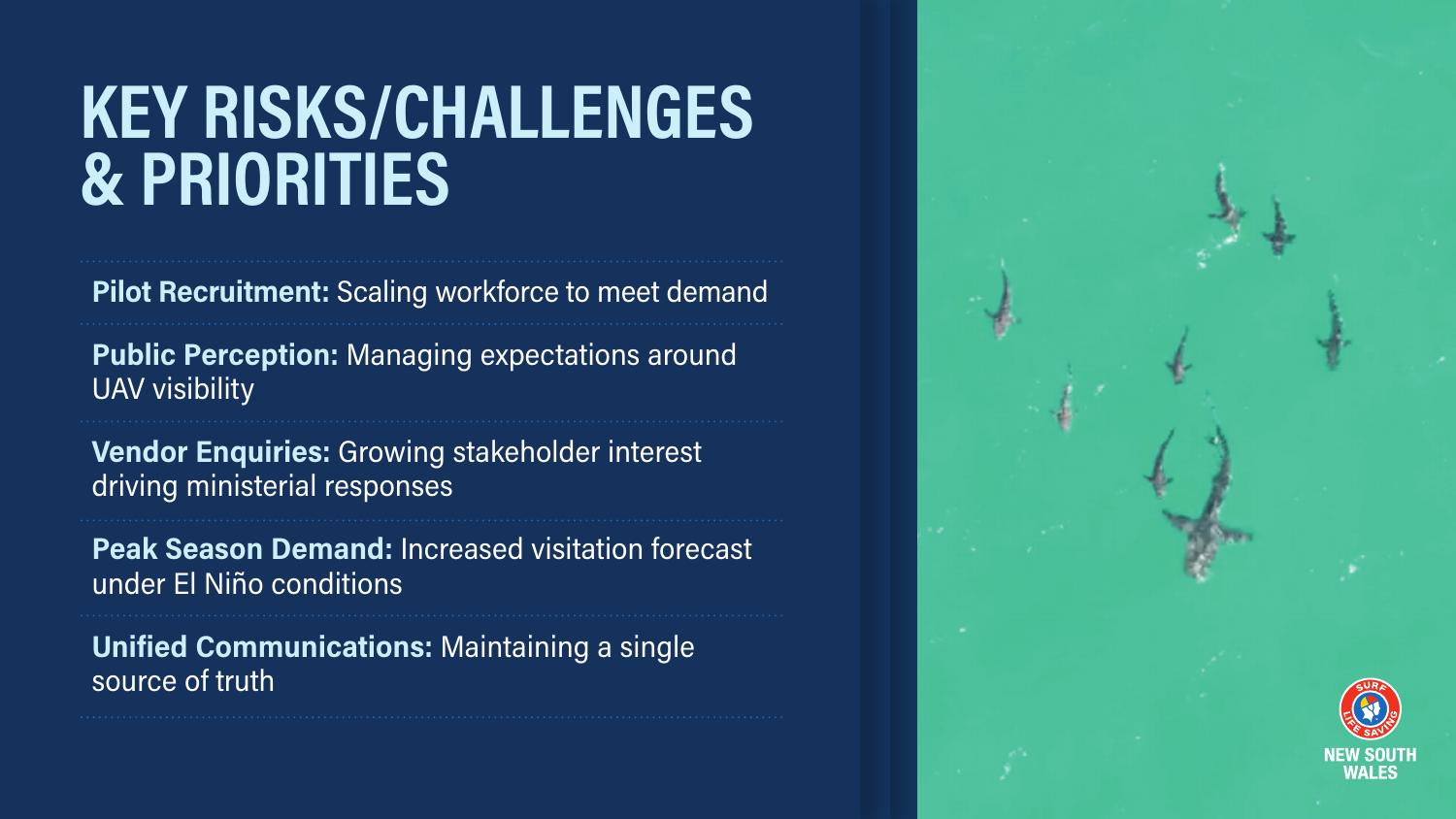
This is where the loop closes. Surf Life Saving NSW's own briefing to the National Water Safety Summit, from the operational agency flying the drones, lists its top current risks and challenges. Sitting alongside genuine operational pressures such as pilot recruitment and peak-season demand is this:[4]
“Vendor Enquiries: Growing stakeholder interest driving ministerial responses.”[4]
That single line is about as close as an internal government slide will come to naming the mechanism directly: commercial and political interest, not incident data, is now a live input shaping resourcing and ministerial attention. It sits directly beside “Public Perception: Managing expectations around UAV visibility”, a workstream concerned with how visible the response looks, not how effective it is.[4]
None of this is a hidden scandal. It is written plainly, by the people running the program, in a room full of their peers. It reads less like an agency trying to obscure what is happening and more like professionals who are navigating a political environment they did not create, and who are being candid about it internally, even while the external messaging leans into reassurance rather than the more complicated picture presented in the same briefing.[4]
Reading This as a Systems Problem, Not a Blame Problem
Put the four datasets next to each other and a coherent picture emerges, not of bad actors, but of a system responding to the wrong signal.[1][2][3][4]
The gap between work-as-imagined and work-as-done is doing a lot of work here. The imagined model, reflected in public messaging and in the pace of the drone build-out, is: more sharks sighted → more visible surveillance → the public is safer. The regulator's own detection data says the first link in that chain does not hold. Abundance and incidents are not shown to move together. The actual mechanism behind the cluster of incidents that triggered this cycle was a specific, weather-linked movement event, which calls for a different kind of control, targeted monitoring and public communication tied to conditions, than blanket year-round surveillance scale-up.[3][4]
This is a proportionality and reasonably-practicable-response question as much as it is a communications question. A precautionary posture is defensible; an infinite one is not. Resourcing decisions made in the shadow of a single high-media-value incident, rather than against a reassessed risk profile, are a textbook outcome-bias pattern, responding to the severity and visibility of the most recent event rather than to its statistical likelihood or causal mechanism.
The same conference session presented two sharply contrasting measures of risk. Surf Life Saving NSW reported an estimated $30 million in media coverage following the Coogee incident and drone response, while separate national data showed that coastal drowning kills more than 40 times as many Australians each year as shark bites.[1][4]
That is not an argument to stand down the shark program. The trauma and consequence of a bite are real, and the mitigation measures NSW has built are, on the international evidence, reasonably effective. It is an argument that the marginal safety dollar and the marginal minute of ministerial and media attention deserve to be allocated against the whole hazard profile, not against whichever hazard most recently generated 3,000 media mentions.[1][3][4]
For anyone with governance or due diligence obligations in this space, the practical takeaway is not to distrust the drone program. It is to insist that the case for its scale, pace and ongoing expansion be made using the regulator's own risk data, which is honest, nuanced and available, rather than the media cycle sitting on top of it. The gap between those two things, mapped out candidly by DPI's own scientist, an independent epidemiologist, an academic who has spent a decade studying this phenomenon and, inadvertently, the delivery agency's own risk register, is the real finding. The alarm is not fabricated. But its intensity, and the resourcing that follows it, are being set by something other than the risk it is nominally responding to.[1][2][3][4]
References
- Madeline Riley, Flinders University and Southern Shark Ecology Group, “A snapshot of shark bites in Australia”, Water Safety Summit 2026.
- Dr Chris Pepin-Neff, Lauren Sandeman and Carmen Dobszewicz, University of Sydney, “Shark Session”, USYD Water Safety Summit, 24 July 2026.
- Marcel Green, NSW Department of Primary Industries and Regional Development, “NSW Shark Management Program 2026/27”, National Water Safety Summit, 24 July 2026.
- Brent Manieri, Surf Life Saving NSW, “NSW Shark Drone Program, Leading Innovation in Beach Safety”, National Water Safety Summit, July 2026.