This article was originally published on LinkedIn on 15 December 2025. It has been moved to the riskfacilitator Insights library so the website remains the permanent source.[1]
Primary sources used to verify and contextualise this archive: [2]
One of the most valuable outcomes of the discussion on my last article wasn’t agreement, but a challenge that highlights the real-world tensions risk professionals navigate every day.
The concern raised was a fair one: “If we keep pushing everything upstream to ‘the system’, does accountability quietly leave the room?” And in the real world, that matters.
Because many of us are at the frontline of safety every day. We don’t deal in theory, we deal in consequences.
That challenge is worth addressing head-on.
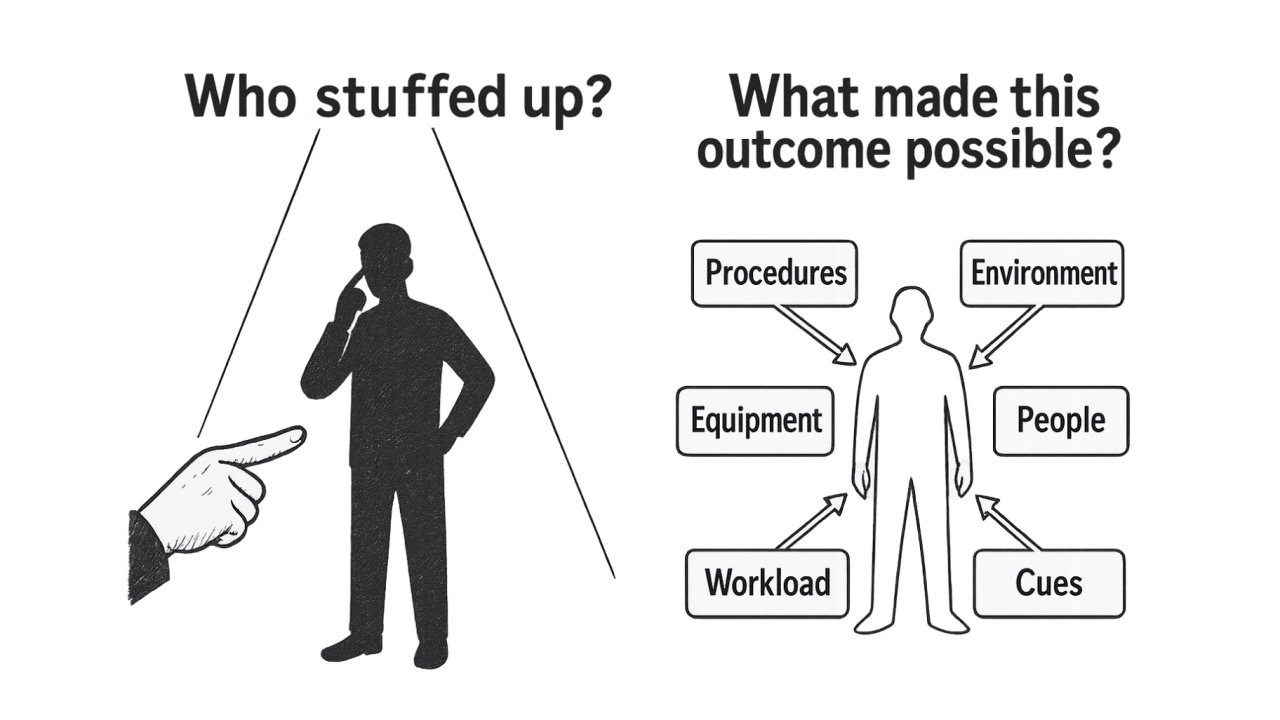
The reality is this: We still spend too much time asking “Who stuffed up?” and not nearly enough time asking “What in the system made this outcome possible?”
Blame feels tidy. System improvement feels harder. But only one of these creates lasting change.
As Deming put it: “Every system is perfectly designed to get the results it gets.”
If the result is an incident, a near miss, or a repeated workaround, it’s telling us something about the system, not the character of the person. And that doesn’t remove accountability. It reframes it.
It’s time we move beyond the habit of labelling things “human error” and start examining how people are actually expected to do the work.
So the real question becomes: How do we do this properly, without letting accountability slip away?
1. Assume actions made sense at the time
Nobody sets out to make mistakes. People take actions that make sense in context, shaped by:
- time pressure
- available cues
- equipment design
- conflicting goals
- unclear procedures
- environmental constraints
- normalised workarounds
Start with one simple question: “Why did this action make sense in that moment?”
This doesn’t excuse behaviour. It allows us to understand it.
And without understanding, improvement is impossible.
2. Replace blame questions with learning questions
Blame-based questions sound familiar:
- Who is responsible?
- Did they follow the rule?
They close conversations.
Learning questions open them:
- What were they trying to achieve?
- What conditions shaped the decision?
- How did the system guide or misguide them?
- What normally helps this task succeed?
The quality of our questions determines the quality of our insight.
3. Look beyond the individual to system conditions
Modern safety thinking, from Hollnagel to Dekker to Conklin, reminds us of something critical: people are not the problem, they are the adaptability in the system.
When things go wrong, the real contributors usually sit upstream:
- unworkable or outdated procedures
- poor interface or equipment design
- excessive workload or fatigue
- signals that are ambiguous or conflicting
- production pressure overtaking thoroughness
- shortcuts that exist because the “right way” doesn’t work
Fixing these strengthens performance for everyone, not just the last person in the chain.
4. Treat violations as information, not misconduct
Most violations aren’t acts of recklessness. They’re signs that Work-as-Imagined doesn’t match Work-as-Done.
Before reacting, ask: “What need was this person solving that the system didn’t solve for them?”
Violations often contain more intelligence about system design than any audit ever will.
5. Build a Just & Fair Culture
This is where accountability stays firmly in the room.
A Just Culture is clear and balanced:
- Human error → console and learn
- At-risk behaviour → coach and understand context
- Recklessness → accountability
This isn’t soft. It’s mature, evidence-based safety governance.
6. Bring Work-as-Done into every review
Procedures describe Work-as-Imagined. Incidents happen in Work-as-Done.
If we don’t examine real tasks, real pressures, and real constraints, we aren’t investigating events, we’re reviewing a fantasy.
Operational learning must start with reality.
7. Improve design, not just behaviour
If tools, environments, workflows, signals, and cues are poorly designed, behaviour will always vary.
Better design delivers:
- clearer decisions
- fewer workarounds
- fewer surprises
- more predictable performance
- safer outcomes
This is the engineering mindset aviation and other high-reliability industries have used for decades. WHS is only now catching up.
8. Strengthen leadership through better questions
Great leaders don’t ask, “Who is to blame?” They ask:
- What surprised us here?
- What in our system made this outcome possible?
- Where did we rely on luck?
- What would help people succeed more consistently?
Curiosity is one of the strongest safety controls an organisation can have.
The payoff is enormous
When organisations stop blaming individuals and start improving systems:
- reporting increases
- trust grows
- incidents reduce
- repeat events disappear
- work becomes more predictable
- teams feel supported, not scrutinised
Good people are not the weak link. They are the strongest part of the system, when the system is designed to support them.
Final thought
Human error isn’t the cause. It’s the clue.
The real opportunity lies in strengthening the design of work, improving system conditions, and enabling people to succeed every day, not just on the days when everything goes right.
If aviation has taught us anything, it’s this: learning, not blaming, is what actually drives safety improvement.
References
- Paul Chivers, A Practical Guide to Improving Systems Without Losing Accountability, LinkedIn, originally published 15 December 2025.
- Safe Work Australia, Principles of Good Work Design handbook, accessed 10 August 2026.