
Boards are often shown safety performance through injuries, claims, lost time and regulatory events. Those measures matter, but they arrive after exposure has already occurred and, sometimes, after harm has developed. A report can therefore look stable while the conditions for future illness are accumulating across the workforce.
Safe Work Australia's 2026 Australian Worker Exposure Survey makes that gap difficult to ignore. It estimates that 68 per cent of Australian workers, about 10.2 million people, were probably exposed to at least one selected hazard agent in the previous week. More than one in five workers were estimated to have been exposed to five or more agents.[1]
In this survey, a “hazard agent” means something workers may be exposed to that can cause harm, such as silica dust, diesel exhaust, ultraviolet radiation or heat. Exposure does not automatically mean injury or illness; the level, duration and effectiveness of controls matter.
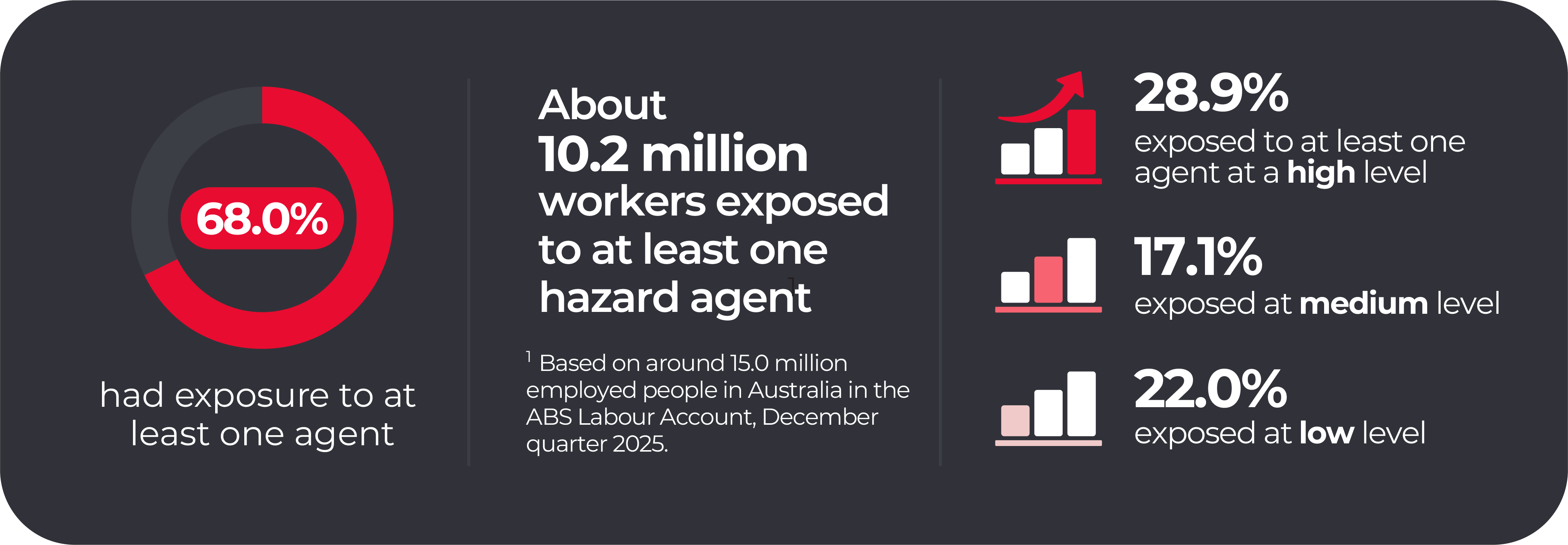
These are not injury figures. They are estimates of probable exposure, derived from the tasks people reported performing and the controls they reported using. Psychosocial exposures were measured through workers' self-reported experience, using questions aligned with the model psychosocial hazards code.[1][2]
That distinction is important. The survey does not prove that 10.2 million workers will be harmed, nor does it measure the conditions inside any particular organisation. It does something more useful for prevention: it shows the scale and distribution of conditions that can create harm before a claim or incident appears.
The system usually sees the consequence first
Traditional safety dashboards tend to privilege events that are easy to count. An injury is recorded. A claim is lodged. A regulator issues a notice. A worker exceeds a monitored exposure limit. Each event creates a visible data point.
Chronic exposure does not always announce itself that way. Solar ultraviolet radiation, heat, diesel engine exhaust, silica, lead and asbestos may be present across ordinary work without producing an immediate reportable event. The absence of a recent injury can therefore say very little about whether the control system is working.
The survey estimates probable solar UV exposure for 32.4 per cent of workers, heat exposure for 29.9 per cent, diesel engine exhaust exposure for 26.3 per cent and silica exposure for 13.6 per cent.[1] Those figures should not be lifted into a company risk register as if they were site measurements. They should prompt a more disciplined question: where could our work create the same exposures, and what evidence would show that our controls are effective?
That question moves assurance upstream. It asks leaders to examine work before harm becomes visible, not simply to review the consequences afterwards.
Exposure is not a single-hazard problem
Many risk systems separate hazards into neat categories. Noise sits in one register, heat in another, chemicals in another and psychosocial hazards in a separate wellbeing program. Work is rarely experienced in those compartments.
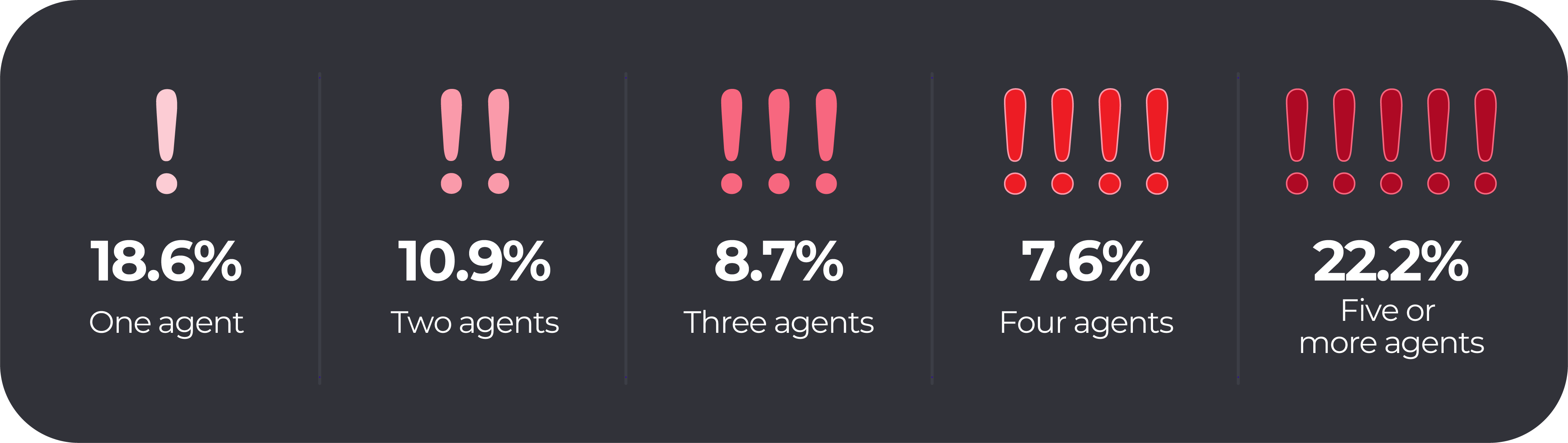
The national survey found high rates of multiple exposure in construction, agriculture, forestry and fishing, and mining. Among construction trades workers, 82.1 per cent were estimated to be exposed to five or more of the selected agents. Apprentices and trainees were more likely to be exposed to several hazards, including heat, silica, lead and asbestos.[1]
The governance implication is not simply that these industries are dangerous. It is that assurance built around one hazard at a time may miss the way conditions combine. Heat can affect concentration. Time pressure can change how respiratory protection is used. Remote work can make assistance harder to obtain. A contractor can move between sites carrying a different mix of exposures each day.
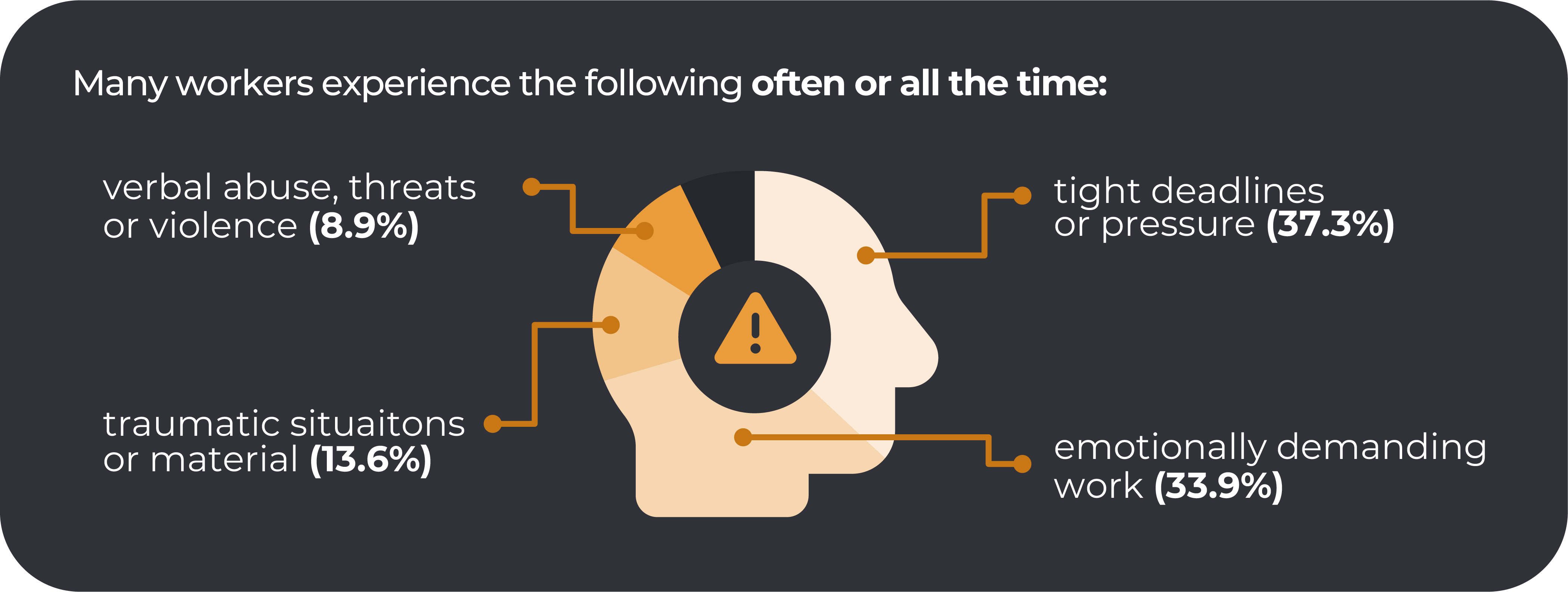
The psychosocial graphic below extends this point to the way work is organised and experienced. In the survey, 37.3 per cent of workers reported tight deadlines or pressure often or all the time, while 33.9 per cent reported emotionally demanding work.[1] For leaders, this is a reason to examine workload, support and work design alongside physical hazards. The survey does not establish that these pressures caused failures in other controls.
Controls may also interact. An enclosure designed to reduce dust could increase heat unless ventilation is considered. A production change intended to reduce manual handling could create a new maintenance or isolation task. Good risk management therefore examines the system of work, not a collection of independent hazard labels.
The data should change board questions, not create another benchmark
There is a predictable temptation to turn a national estimate into a performance target. If the national exposure rate is 68 per cent, an organisation may want to demonstrate that its own rate is lower. That comparison would be weak unless the organisation used a compatible method, scope and definition.
AWES involved 6,617 workers aged 15 and over who completed a structured online or telephone survey between December 2025 and February 2026. Physical and chemical exposure was estimated using OccIDEAS, a task-based system developed with occupational hygiene and epidemiological input. It is a national surveillance instrument, not a substitute for workplace-specific identification, monitoring or health surveillance.[2]
The better use of the findings is to challenge the quality of internal intelligence. Does the organisation know which tasks create exposure? Can it identify affected groups, including apprentices, labour-hire workers and contractors? Does it understand combinations of hazards? Are control assumptions based on design documents, or verified in the work itself?
Those questions are especially important where the dashboard remains green because illness has a long latency or because workers move between employers. A clean claims history can coexist with poorly understood exposure.
From lagging performance to exposure assurance
An exposure-focused assurance process does not need to become another reporting burden. It needs to connect four things that are often separated: the task, the hazard, the control and the evidence.
For a critical exposure, leaders should be able to see what work creates it, who may encounter it, what higher-order controls reduce it and how those controls are verified. They should also see the conditions that can degrade performance, such as production changes, weather, maintenance, contractor interfaces or work outside normal hours.
This is different from asking whether a procedure exists. A procedure may describe local exhaust ventilation, wet methods, shielding or isolation. Assurance asks whether the system is present, available, correctly used and effective under real operating conditions.
The hierarchy of controls remains relevant because control quality matters. Safe Work Australia describes elimination as the most effective option, followed by substitution, isolation and engineering controls, with administrative controls and personal protective equipment lower in reliability.[3] Exposure data should help organisations test whether they are relying too heavily on the person at the point of risk.
A practical governance test
The survey creates a useful starting point for the next risk or safety committee meeting. Select one exposure that is plausible in your operations and ask for the evidence chain.
Where does the exposure arise? Which workers and contractors may be affected? What is the most reliable control reasonably practicable? How was its effectiveness verified? What change would cause the risk to be reassessed? What information reaches the board before somebody is injured or becomes ill?
If those questions cannot be answered without waiting for a claim, an incident or a regulator visit, the organisation does not yet have leading indicators. It has early versions of lagging ones.
The new national data does not tell a board whether its workplace is safe. It tells us why an absence of recorded harm is not enough.
References
- Safe Work Australia, Insights from the Australian Worker Exposure Survey 2026. Accessed 28 September 2026.
- Safe Work Australia, Australian Worker Exposure Survey. Accessed 28 September 2026.
- Safe Work Australia, Control the risks. Accessed 28 September 2026.
Survey graphics: Safe Work Australia, AWES 2026.